On the IQ rankings of major dogs, Siberian sled dogs, also known as huskies, are often fixed at around 45th. This ranking is mainly based on the criteria proposed by Dr. Stanley Collen in his book "Dog Intelligence", namely the speed and obedience of learning to unfamiliar instructions. As a result, labels such as "Erha","IQ Basin", and "Hand Off" were firmly adhered to them. However, any owner who has really been with a husky for a long time will wonder: Is this guy really stupid? Or does its wisdom exist in a form that we have not yet fully understood or even grossly underestimated? Today, we come to name this "ice and snow prince" and reveal his true veil as a "scheming dog".
1. The "trap" of IQ rankings: We misunderstand the definition of "smart"
First, we must understand the limitations of canine IQ rankings. Dr. Collen's ranking focuses more on "work obedience IQ", the ability to quickly understand and blindly follow human instructions. Under this system, dog breeds such as border collies and poodles that are highly cooperative and pleasing to humans are naturally among the best. But the ancestors of the Husky were bred in the extremely cold Siberian wilderness as working dogs to drag sleds, navigate independently, and conserve physical strength. Their "intelligence" is reflected in completely different dimensions:survival wisdom, independent decision-making ability and problem solving ability .
Imagine that in a snowstorm of tens of degrees below zero, the leader dog needs to judge the thickness of the ice, choose the most labor-saving route, and even find the way home by instinct when the owner loses his way. This kind of wisdom related to life and death is far more complex and advanced than obeying orders such as "sitting down" and "shaking hands." The husky preserved this powerful independent gene intact. It's not that they can't understand your instructions, but that after listening, they will use their brains to quickly do a "cost-benefit analysis":"Why should I do it? What is the benefit of doing it? Can I bear the consequences of not doing it?" In the eyes of humans, this characteristic of independent thinking becomes "stubborn" and "disobedient", and is then misunderstood as "stupid".
2. The big revelation of "scheming": Husky's high emotional intelligence and strategic behavior
To say that the husky is "scheming" is by no means a derogatory expression, but an admiration for its superb social skills and ability to cope with situations. Many of their behaviors are full of strategy.
1. Selective deafness and situational memory
This is what Husky owners often complain about. Call it by name, and it doesn't respond, as if its ears were just decoration; but if you gently rip open the snack bag, it will appear in front of you in an instant no matter where it is in the room or how deep it sleeps. This was not a hearing problem, but ratheran extremely accurate ability to filter information. They are perfect for distinguishing between "irrelevant calls" and "signals of vital interest (food, going out)." They also have strong situational memory. If you take him to the park every time you pick up his leash, he'll go crazy with the act of "taking the leash"; if you cut his nails after every shower, he'll probably start hiding at the sight of a towel. They are very good at associating specific scenes with subsequent events.
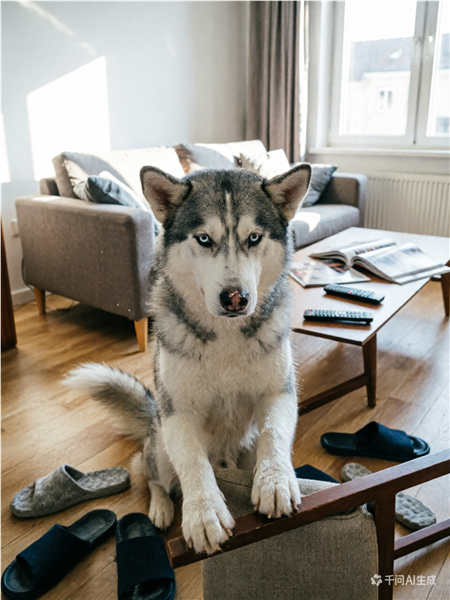
2. The logic behind home demolition: not destruction, solution
Husky's demolition behavior has caused countless owners to collapse. But please think about it from another perspective: What would a sled dog with extremely high energy and requiring a lot of exercise and work every day do if it was locked up alone in a small, boring room for more than 8 hours? It feels anxious and has nowhere to vent its energy. As a result, biting sofas, chewing doorframes, and peeling walls have become the work and entertainment projects it "creates" for itself, and it is aspontaneous solutionto the problem of "boredom" and "anxiety". This just proves their strong ability to proactively solve problems (although solutions are not accepted by humans), rather than brainless destruction.
3. The superb art of "escape master"
Huskies are masters at prison escapes. Opening cages, opening simple latches, or even collaborating on jailbreaks (one attracts attention and the other operates) is no problem for them. This requires complex logical thinking: observe (the structure of the latch), try (pluck it with your paw or nose), summarize (what force and angle work). The whole process is a completetrial-and-error learning cycle, which is a reflection of advanced cognitive abilities. They are not blindly bumping into each other, but are systematically solving the problem-"how to gain freedom."
4. Superb social and "shaking" skills
Huskies are often excellent "socialists" in dog groups and families. They know how to communicate with other dogs or humans through body language, cries and expressions. What's even more "scheming" is that when they make a mistake (such as stealing food on the table), you may see it looking innocently at another dog or cat in the house, trying to divert the "suspect" target. This kind of framing requires them to understand "causality"(if I do something bad, the owner will be angry) and "responsibility"(let other creatures bear the responsibility), which has touched on a very complex level of psychological activities.
3. The shining points of underestimated wisdom
In addition to the above-mentioned "scheming" behaviors, the Husky has shown extraordinary wisdom in many aspects:
- Strong navigation and spatial memory capabilities:Many lost huskies can find their way home with their amazing sense of direction, or remember complex paths over large areas.
- Excellent cold tolerance and physical management wisdom:They know how to curl up to preserve body temperature when cold, and reasonably allocate physical strength when pulling sledding. This is a survival intelligence deeply rooted in their genes.
- Sharp environmental observation:They are very sensitive to subtle changes in the environment (such as family members 'emotions, new items at home) and respond accordingly.
- Excellent communication and expression skills:Huskies rarely bark, but they have a rich "language library"-howling, humming, and muttering in various tones, coupled with rich facial expressions (the source of the famous "emoji pack") and physical movements, can express needs, dissatisfaction or happiness very clearly.
4. How to "control" this smart and independent brain?
After recognizing the intelligent qualities of huskies, traditional "command-and-obey" training often results poorly. You need to be its "partner" rather than its "commander."
- Motivational drive:Find the rewards it really cares about (it could be food, toys, or the opportunity to go out and play) and use the rewards to guide behavior rather than coercion.
- Let it "use your brain":Provide a large number of toys that require brain use, such as food leakage balls, hidden food mats, and puzzle unlocking toys. Gamize training, such as hiding snacks and letting it find it.
- Meet core needs:Providesufficient, high-intensity exercise (at least 1-2 hours of running a day) and opportunities for exploration. An exhausted husky is a good husky.
- Maintain patience and consistency:Understand its independent thinking nature and communicate patiently. Establish clear rules and implement them consistently, and it will slowly learn how to coexist comfortably in human society.
- Early socialization:Allowing him extensive exposure to different people, dogs, environments and sounds during his puppy life can help him better use his wisdom to deal with the world and reduce anxiety and inappropriate behavior.
5. Conclusion: Ranked 45th? No, it's just a genius from another dimension
So, back to the original question: Does the Huskies really rank 45th in IQ? Judging from the servant-like IQ standard of "obedience", maybe so. But from the perspective ofindependent survival, creative problem solving, situational analysis and social strategies, huskies are undoubtedly "thinkers" and "strategists" among dogs. They are not stupid, but they are too assertive; they are not stupid, but they use their wisdom in unexpected places.
Raising a husky is like living with an unruly and intelligent soul from Ice and Snow Wilderness. It won't bow to you, but it may rub its head against you when you are depressed and howl with you when you are happy. It loves its family and protects its territory in its own unique way (although the way may be by tearing up invading delivery boxes). When you no longer use "obedience" as the only yardstick to measure intelligence, you will find that this "scheming dog" ranked 45th actually has a wild, bright and seriously underestimated wisdom. Respect its nature and guide its energy, and you will gain an extremely interesting and surprising life partner. After all, who can resist a furry strategist who brings you new "surprises" and emoticons every day?
(This article aims to explore the cognitive characteristics of huskies from a behavioral perspective and provide a new perspective for pet owners. Each dog is an independent individual and has differences in personality and behavior. Scientific feeding, patient training and loving companionship are the keys to living harmoniously with any pet.)