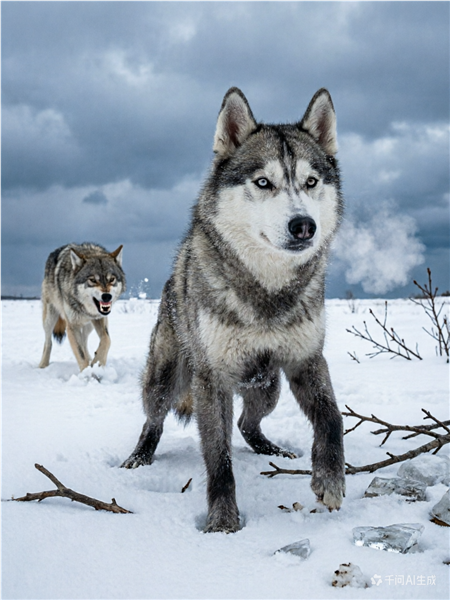
Whenever night falls, or when you hear the sound of sirens from afar, will your furry "Erha" raise his neck and make a long and penetrating "Ow ~~~"? This behavior, known as "wolf howling", is in sharp contrast to the "barking" of most dogs and has become one of the most unique and charming labels of the husky breed. Many owners can't help but wonder: Why does my husky not like to bark like other dogs, but just like to "sing"? Behind this, there are complex reasons from ancient blood to modern life.
1. Echoes of ancient times: Wolf memories engraved in genes
To understand the wolf howling of husky dogs, we must first trace back to their origin. Husky, officially known as the Siberian Mallet Dog, is one of the oldest dog breeds in the world. Their ancestors lived in the cold Siberian region for a long time and were cultivated by the Chukchi people and mainly used for sledding and companionship. In the harsh natural environment, they are relatively close to wolves and retain more of the physiological and behavioral characteristics of wolves, including their vocalization style.
Wolves use howling to communicate over long distances, and their sounds can travel for kilometers. Howling can help scattered wolf pack members regroup, declare territorial ownership, coordinate hunting operations, and even just maintain group contact. For the ancestors of the husky, on the vast snowfield, this efficient and long-range communication method is far more valuable than the short and limited range "barking" barking. Therefore, the tendency to "howl" rather than "bark" is deeply written into the husky's genes as a successful survival strategy.
2. The art of communication: howling is their "language"
The husky's howling is not meaningless noise, but a complex social language. They express a variety of different emotions and intentions through howling:

- Loneliness and calling:This is one of the most common reasons. Huskies are social animals and have a high need for companionship. When the owner leaves home for a long time, or when it feels isolated, it may howl to express loneliness and anxiety, trying to call his "companion" back. This is similar to the behavior of wolves when looking for lost companions.
- Excitement and invitation:When you come home from work or are about to take it out to play, some huskies will howl excitedly. The howling tone at this time may be higher, shorter, full of joy, an expression that invites you to join its happy world.
- Response and resonance:Huskies are particularly sensitive to certain high-frequency sounds and are prone to "resonance" reactions. Common trigger sounds include: sirens, ambulances, musical instruments (such as sax, violins), the howling of other dogs, and even certain sound effects on TV. They seemed to think that these voices were calls from distant "companions", so they instinctively joined the "chorus".
- Territory declarations (relatively rare):Although not as typical as wolves, some huskies also respond to external interference by howling and declaring their existence.
3. Effects of physiological structure: the vocal system born for long cries
In addition to behavioral instincts, the husky's physiology is also better suited to long howls rather than short barks. Their vocal cords and throat structures are similar to those of wolves, allowing them to more easily regulate the airflow and emit the long, undulating, and varied howls. In contrast, a typical "barking" bark requires a faster and more explosive interruption of the airflow, which is not dominant in the husky's vocal habits. It can be said that their bodies are designed for "singing".
4. Howling vs. barking: The fundamental difference in functionality
Understanding the functional differences between howling and barking is the key to solving the mystery. In canine ethology:
- Bark:Usually used to warn, alert, excite or attract attention over short and medium distances. The sound is short, repetitive, and highly targeted. It is often used to respond to specific stimuli in front of you, such as strangers knocking on the door or seeing squirrels. Many guard dogs or terriers use this method of communication more often.
- Howl:Mainly used for long-distance communication and group coordination. The sound is long and spreads over long distances, focusing more on expressing states (such as location, emotions) and maintaining group connections than responding to immediate threats.
As a working sled dog, Huskies have historically needed to maintain contact with teammates and human drivers in a vast space. Therefore, they have developed and maintained a communication model dominated by howling and supplemented by barking. It's not that they can't bark, but in many situations, howling is their "first choice."
5."Singers" in modern life: How to get along with howling huskies
For husky owners, understanding howling is the first step in accepting their nature. It is difficult and unfair to ban this instinctive behavior completely. The key lies in reasonable guidance and management:
- Meet social needs:Provide adequate companionship and social interaction. To avoid leaving huskies alone for long periods of time, consider dog day care or finding a reliable dog companion to reduce the howling caused by loneliness.
- Enough exercise and mental exhaustion:An exhausted husky is a good husky. Ensure at least 1-2 hours of high-intensity exercise (such as running and pulling cart training) and puzzle games every day to consume their excess energy and significantly reduce howling caused by boredom and anxiety.
- Manage triggers:If it responds strongly to a specific sound (such as a siren), use snacks, toys, or instructions to distract it when the sound appears, associating its response with positive things.
- Don't reinforce your wrong behavior:When it cries for a need (such as snacks), don't immediately satisfy it, which will allow it to learn to use howling to "threaten" you. Wait until it cools down before giving a reward.
- Set up a "singing time":Some owners will actively encourage dogs to howl at specific times (such as playing before going to bed), turning this into a fun interactive game that satisfies their nature, while also letting them understand that they need to be quiet at other times.
It is worth noting that if the husky's howling suddenly becomes abnormally frequent, shrill, or is accompanied by other abnormal behaviors (such as pacing, destruction, loss of appetite), it may be a sign of health problems or deep anxiety, and a veterinarian or professional dog behavioral scientist should be consulted promptly.
Conclusion: Listen to the song from the snowy plains
The husky's wolf howling is not a defect or a deliberate disturbance, but a echo of their ancient souls and a communication poem engraved in their genes. When your husky raises its head and shouts at the moon, or joins a chorus to the sound of sirens, you hear more than just a sound, but an affectionate conversation between an ancient dog breed and you across time and space. It may be telling the missing of its companions, expressing its joy at the moment, or simply confirming: "I am here, are you there?" As a master, understand and respect this unique way of expression, guide it with patience and wisdom, and you will find that every "howl" of this "singer among dogs" is the most unique and most touching background music in your common life. Accepting its singing voice means truly accepting the husky's complete soul that is free and uninhibited but affectionately dependent.